


The cashew market in 2026 is not where most buyers expected it to be. Supply is tighter, prices are elevated, and the window for comfortable procurement decisions is narrowing fast.
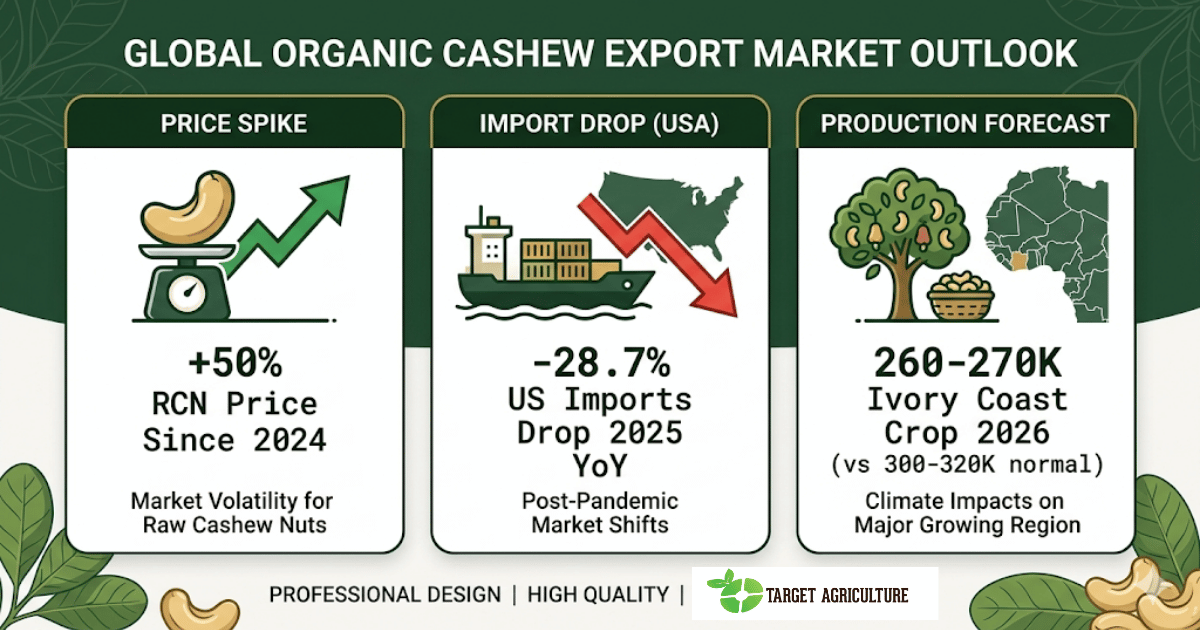
Three data points define the cashew market in mid-2026 — and they all point in the same direction.
- First, tight raw nut supplies drove prices from USD 1,000 to USD 1,500 per metric ton following West African weather setbacks (Mordor Intelligence, 2026) — a 50% price increase that has compressed processor margins and pushed landed costs higher for importers sourcing on a spot basis.
- Second, West African supply is below normal. Côte d'Ivoire's 2026 crop is currently estimated at 260,000–270,000 tons — below the normal range of 300,000–320,000 tons, with early arrivals showing lower outturn than previous years (Commodity Board, March 2026). The second crop remains uncertain.
- Third, US demand disruption has created inventory ambiguity across the supply chain. The United States ended 2025 with a 28.72% decline in cashew kernel imports, falling to 125,753 MT from 176,423 MT in 2024 (Commodity Board, March 2026). Whether that reflects depleted inventory or genuine demand destruction is the question every trader is watching — and the answer will shape H2 2026 pricing.
Taken together: supply is down, costs are up, and the outlook for price correction is uncertain.
Everything above applies to conventional cashew trade. For certified organic buyers, the exposure is amplified.
Organic raw cashew nuts represent a small fraction of global supply. When conventional availability tightens, organic supply tightens faster — because there are fewer certified farms, no ability to substitute non-certified origins, and a documentation trail that must be rebuilt from scratch for every shipment.
EU maximum residue limits and US Food Safety Modernization Act traceability rules are raising compliance costs — adding USD 20–25 per metric ton for smaller exporters — nudging the market toward larger, well-capitalised suppliers that can certify chain of custody documentation (Mordor Intelligence, 2026).
The practical result: the pool of credible certified organic cashew suppliers is smaller than it appears from a price list, and available volume is being committed earlier in the cycle than most buyers expect.
If demand were slowing, tight supply would be manageable. It is not slowing.
The global cashew market is expected to grow from USD 9.9 billion in 2025 to USD 10.57 billion in 2026. Certified organic kernels earn 15–20% premiums in US and European retail. China's tree-nut intake is rising 5% annually, with per-capita consumption forecast to reach 1 kilogram by 2030 — nearly double 2023 levels (Mordor Intelligence / USDA FAS, 2026).
Demand is growing. Supply is constrained. The premium for certified organic is holding. This is not a market that rewards patience.
This is the part most market reports skip. Here is a direct answer:
If you have existing supply agreements — review them now.
Check whether your certified volumes for Q3 and Q4 are locked. If they are not, assume available supply is tighter than your supplier's last email suggested. Ask specifically about lot allocation, not just general availability.
If you are still sourcing on a spot basis — stop.
Spot buying in a supply-constrained market means you are always getting what is left after contract buyers have taken their volume. In a normal market, that is manageable. In this market, it means paying above the already-elevated price for grades below your specification.
If you are evaluating new suppliers — ask two questions.
One: how long have you held continuous organic certification? Organic supply chains take years to build. A supplier who received EU Organic certification 18 months ago has not been tested through multiple crop cycles, multiple audits, and multiple tight seasons. Two: can you provide transaction certificates from the last three shipments? If the documentation is not immediately available, the supply chain is not as documented as the pitch deck suggests.
If you are planning to expand your organic cashew range — start the conversation now.
The processed cashew market is projected to expand at a CAGR of 5.8% from 2026 to 2036, growing from USD 6.3 billion to USD 11.0 billion (Future Market Insights, 2026). The brands entering the category now are locking in supplier relationships before the market gets more competitive — not waiting until it does.
Target Agriculture Group has held continuous certified organic operations since 1995 — through multiple crop cycles, multiple market disruptions, and multiple regulatory changes. Our Vietnam supply chain sources directly from certified farms in Binh Phuoc, processes through dedicated organic facilities, and exports under EU Organic, USDA-NOP, JAS, Naturland, Fairtrade, BRC, and SMETA certification.
In the first two months of 2026, Vietnam's cashew kernel exports reached 74,888 tons at an average of USD 6,857 per ton (Commodity Board, March 2026) — confirming that Vietnamese processors with established supply chains are still moving volume at scale.
We are not a spot market supplier. We are a supply chain partner — and in 2026, that distinction matters more than it did in 2024.
👉 Contact Target Agriculture to discuss certified organic cashew availability, volume allocation, and supply agreements for H2 2026 and 2027.
 YOUTUBE - LINKEDIN