


Cashew supply keeps swinging on weather and single-country risk. Buyers sourcing from one origin absorb that shock alone — multi-origin sourcing is how the market's leaders are spreading it.
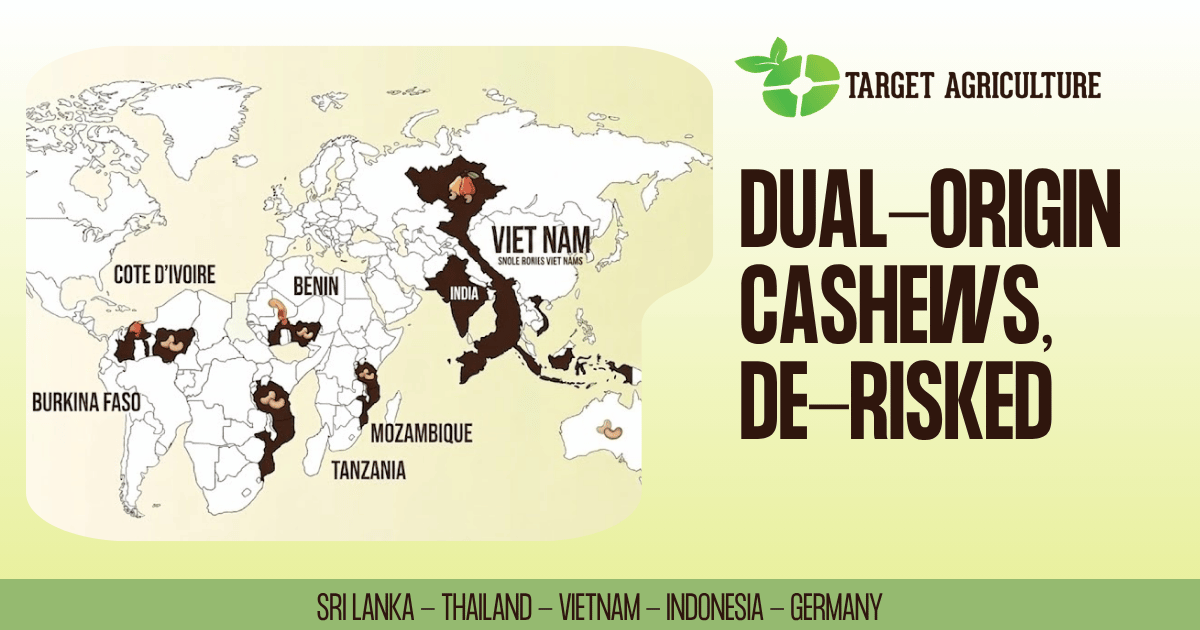
- After 2025's oversupply, cashew prices stabilized across major grades (WW180, WW240, WW320) through mid-2026.
- West Africa's 2026 harvest ran longer but delivered lower quality, adding fresh climate-driven volatility.
- Multi-origin diversification and climate resilience are becoming the sector's next competitive advantage.
- Target Agriculture Group sources organic cashews across two countries — Vietnam, Sri Lanka.
- For procurement teams, the question is shifting from "cheapest price" to "most resilient supply chain."
Mid-2026 brought relief after a year of oversupply pressure: surplus inventories leveled out, and prices for major grades found firmer footing, with demand holding steady across Europe, China, and the Middle East (Certified Origins Nuts Market Report). This builds on the tighter conditions covered in our Global Cashew Market 2026 outlook — but "stable" doesn't mean "predictable": tightening supply in competing tree nuts like almonds and pistachios keeps cashews in a strong but still shifting position.

West Africa's 2026 harvest stretched longer than usual across Guinea-Bissau, Senegal, and Côte d'Ivoire, but quality came in lower than last year's exceptional crop, compressing processor margins. This is the pattern buyers now plan around: strong demand sitting on top of increasingly unpredictable, origin-specific harvest conditions.
When one origin underperforms, buyers relying on a single country absorb the full impact — price spikes, quality gaps, shipment delays. Industry analysis increasingly frames climate resilience and multi-origin diversification as a genuine competitive advantage, not just a hedge (Mordor Intelligence Global Cashew Market Report). Certified organic kernels keep earning a premium precisely because buyers pay for consistency they can rely on.

Target Agriculture Group sources and processes certified organic cashews across Vietnam, Sri Lanka. If one origin faces a weak harvest or logistics disruption, buyers working with Target Agriculture aren't limited to a single supply line — the group's footprint spreads that risk across four supply chains, each independently certified and traceable.
H2 2026 is shaping up around four forces: stronger retail demand, tighter stocks in competing nuts, growing African processing capacity, and continued climate volatility. For buyers, the priority is no longer just locking in the lowest price — it's securing a supplier structure that can absorb a bad harvest anywhere without leaving them exposed.
Cashew sourcing in 2026 rewards buyers who plan for volatility, not just price. At Target Agriculture, our four-country organic cashew supply chain gives buyers a genuine hedge against single-origin risk, backed by certification and traceability at every step.
👉 Looking to reduce single-origin risk in your cashew sourcing? Contact Target Agriculture to discuss a multi-origin supply strategy for your business.
What is multi-origin cashew sourcing? Sourcing cashews from more than one producing country, so a poor harvest in one origin doesn't leave a buyer without supply.
Why did cashew prices stabilize in 2026? Surplus inventories from 2025's oversupply cleared, while demand held steady across Europe, China, and the Middle East.
Why is West Africa's 2026 harvest a concern for buyers? It ran longer than usual but delivered lower raw nut quality, adding volatility despite high overall volumes.
How does Target Agriculture reduce single-origin risk? By sourcing certified organic cashews across two countries — Vietnam and Sri Lanka.
Is multi-origin sourcing more expensive than single-origin? Not necessarily — it costs more to manage upfront, but reduces the risk of spike prices or no supply when one origin underperforms.
 YOUTUBE - LINKEDIN