


SO₂ levels can affect compliance, labeling, and buyer acceptance. Understanding how sulfites are controlled helps importers choose a reliable dried mango supplier.
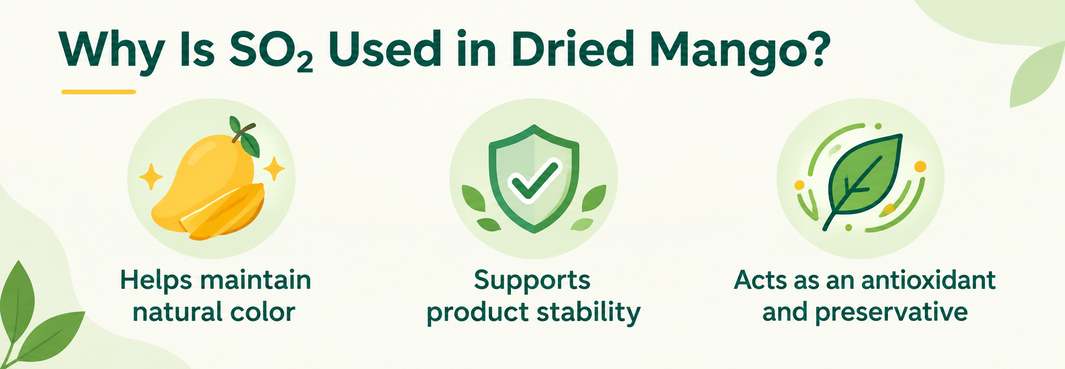
Fresh mango naturally changes color when exposed to oxygen during processing. For dried mango manufacturers, controlling this change is important because consumers and retailers often expect the product to retain an attractive, natural-looking appearance throughout its shelf life.
Sulfur dioxide (SO₂) and other sulfiting agents may be used in dried fruit processing because of their antioxidant and preservative functions. They can help control oxidation and support product stability.
However, SO₂ is not simply a matter of adding a fixed amount during processing. The final residual level depends on factors such as the treatment process, mango characteristics, drying conditions, and storage.
For importers, the important question is therefore not only “Is SO₂ used?”, but also “How is it controlled in the finished product?”
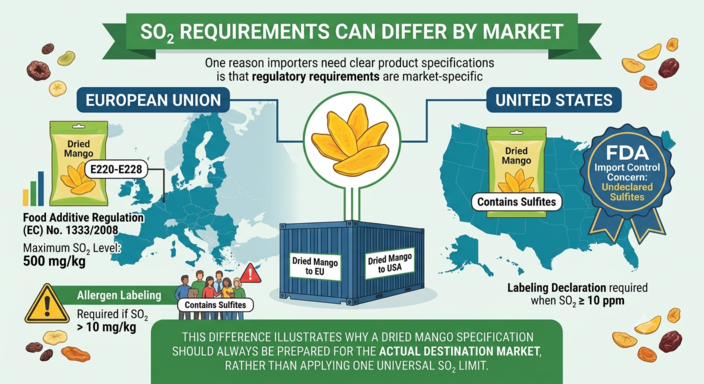
One reason importers need clear product specifications is that regulatory requirements are market-specific.
In the European Union, sulfur dioxide and sulfites are regulated as food additives under Regulation (EC) No. 1333/2008. For the category of dried fruit and vegetables, the current EU legislation lists E220–E228 at a maximum level of 500 mg/kg expressed as SO₂ for dried fruit and nuts in shell, with specific exclusions for certain dried fruits.
The EU also treats sulfur dioxide and sulfites as substances requiring allergen information when used above 10 mg/kg or 10 mg/L, expressed as total SO₂, under its food information requirements.
The United States uses a different labeling framework. FDA requires sulfiting agents to be declared when they are present at 10 ppm or more, subject to the applicable conditions, and FDA specifically identifies undeclared sulfites in dried fruits as an import-control concern.
This difference illustrates why a dried mango specification should always be prepared for the actual destination market, rather than applying one universal SO₂ limit — the same principle that applies across our export categories (see EU Compliance Testing: What an Organic Cashew Exporter Vietnam Needs for how we approach this on the cashew side).
Good SO₂ management begins with the production process.
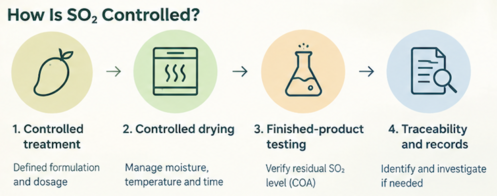
The use of sulfiting agents should follow a defined formulation or processing specification. Consistent treatment helps reduce variation between production batches.
Drying is another important step. Moisture, drying time, temperature, and fruit characteristics can influence the final product's texture, color, and stability.
A supplier should therefore manage SO₂ together with other key parameters rather than treating it as an isolated laboratory test.
Laboratory analysis can verify the residual SO₂ level in the finished dried mango.
For B2B buyers, the COA should clearly identify the tested parameter and result, while the agreed product specification should define the applicable requirement.
If an SO₂ result falls outside the agreed specification, production and testing records should allow the supplier to identify the relevant lot and investigate the cause.
This becomes especially important for export shipments, where a quality issue can affect customs clearance, labeling, or customer acceptance.
Before placing an order, buyers can ask several practical questions:
- Is SO₂ used during processing? The supplier should clearly state whether sulfur dioxide or another sulfiting agent is used.
- What is the agreed SO₂ specification? Instead of relying on terms such as “low sulfite,” ask for a defined specification.
- How is SO₂ monitored? Ask whether the supplier relies on process controls, finished-product testing, or both.
- Can the supplier provide a COA? The COA should support verification of agreed quality and food safety parameters.
At Target Agriculture Group, dried mango quality is managed through a combination of raw material control, processing controls, product specifications, laboratory testing, and traceability.
Our quality approach is designed to connect the characteristics of the fresh mango with the requirements of the finished export product. Parameters such as moisture, SO₂, microbiological quality, and other customer-specific requirements can be incorporated into the product control plan according to the target market.
Target Agriculture works with international buyers seeking reliable Vietnamese dried mango with defined specifications and quality control throughout the export supply chain. Contact us to discuss your product requirements and target market.
 YOUTUBE - LINKEDIN