One complaint can put a whole shipment at risk. See how an Organic Cashew Exporter Vietnam uses lot traceability to contain it.
One complaint can put a whole shipment at risk. See how lot-based traceability helps cashew buyers contain nonconforming product, substantiate root causes, and verify corrective actions.
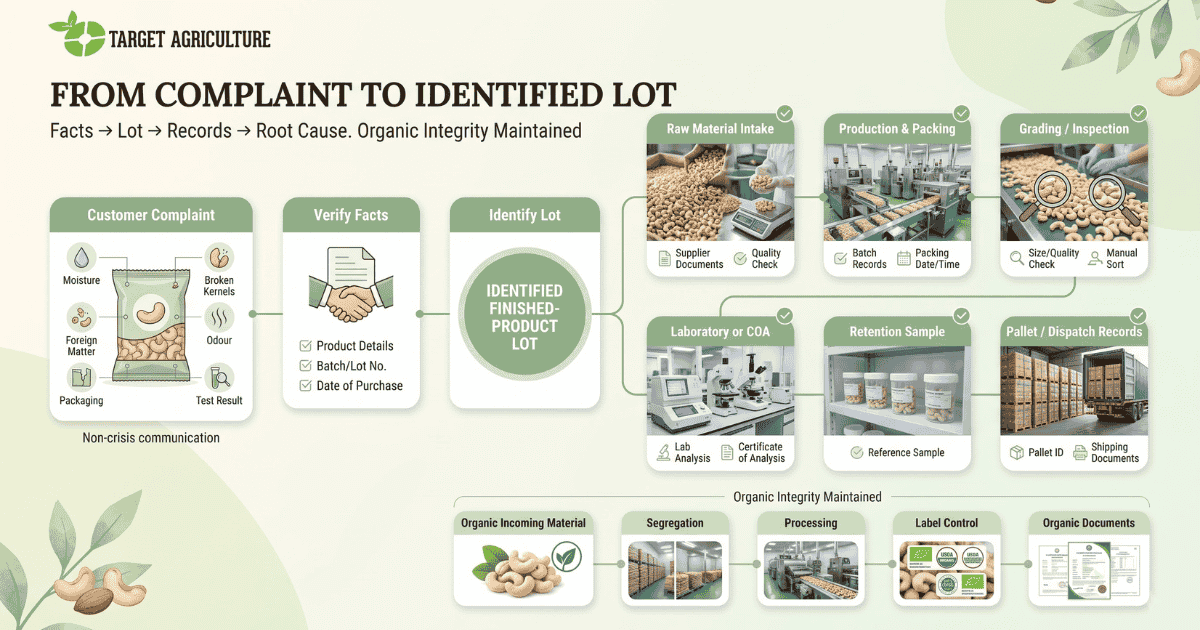
When a buyer reports elevated moisture content, excessive broken kernels, extraneous matter, off-odour, compromised packaging, or a test result outside the agreed specification, the response starts with facts—not assumptions. The quality team verifies the product code, contract specification, lot or batch number, affected quantity, delivery date, sampling plan, certificate of analysis or laboratory report, and supporting photographs.
This information links the complaint to a specific finished-product lot. The team can then retrieve raw-material intake records, production and packing records, grading and defect-sorting results, in-process inspection records, metal-detector or X-ray verification where applicable, retention samples, palletisation records, and dispatch documentation. Clear lot identification keeps the investigation focused and prevents unrelated inventory from being placed on hold without justification.
For an Organic Cashew Exporter Vietnam, the same traceability chain must also maintain organic integrity. The organic status of incoming materials, physical or temporal segregation, processing records, label control, and organic transaction documentation must remain linked throughout handling and production.
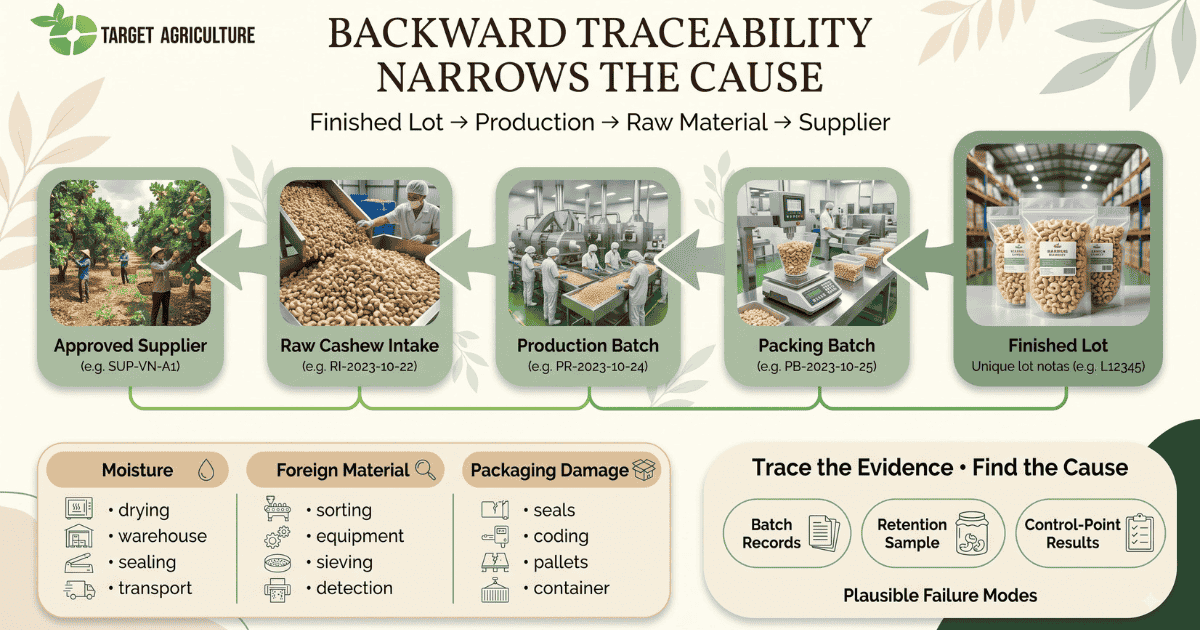
After confirming the affected finished-product lot, the team performs backward traceability through the packing batch, production batch, raw cashew nut intake lot, and approved supplier or producer group. Every receipt, transfer, processing step, and repacking activity must preserve lot identity. A missing link weakens both the root-cause investigation and the ability to define the affected scope.
The reported nonconformity determines which records require review. A moisture-content deviation may lead to drying and conditioning parameters, warehouse temperature and relative humidity, inner-liner sealing, container stuffing conditions, and transport exposure. Extraneous matter requires a review of manual or optical sorting, line-clearance records, equipment condition, sieving, magnets, metal detection, or X-ray controls as applicable (see our approach to foreign body and allergen control). Packaging damage may involve material specifications, seal integrity, coding and label control, pallet handling, container condition, or distribution damage.
Traceability does not establish causation by itself. It defines the evidence population for the root-cause investigation, allowing the quality team to review batch records, examine retention samples, verify control-point results, and evaluate plausible failure modes.
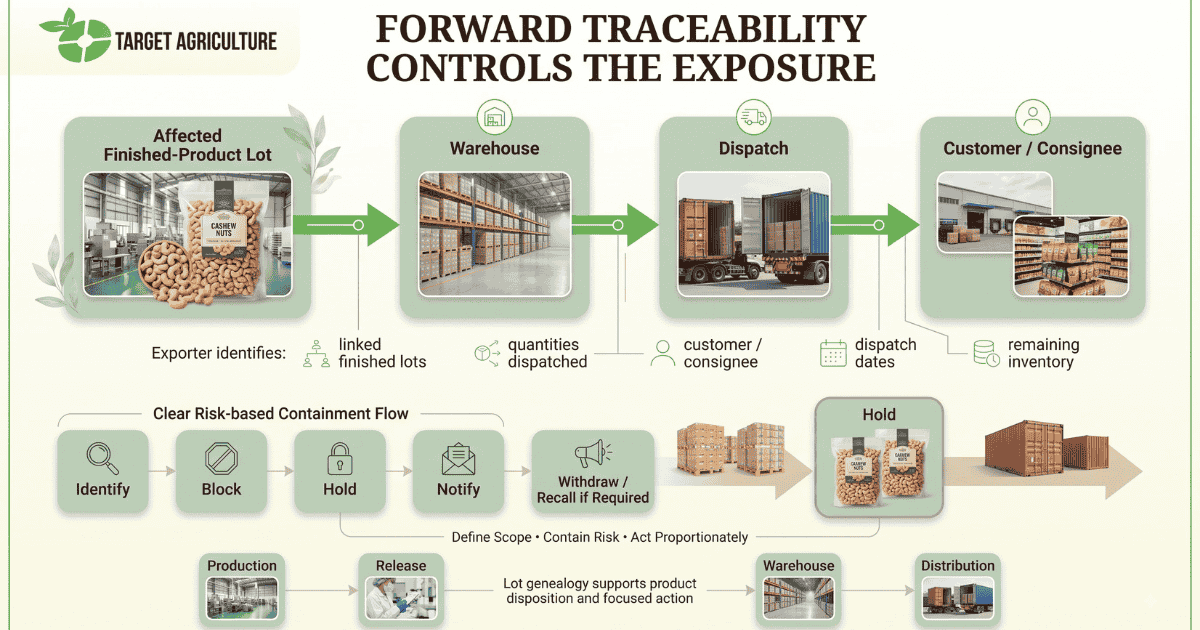
If the risk assessment identifies a credible food-safety, legality, authenticity, or quality concern, forward traceability determines the disposition of associated product. The exporter should be able to identify linked finished-product lots, quantities dispatched, consignee or customer locations, dispatch dates, and inventory remaining under its control.
This supports risk-based containment. Defined lots can be blocked in the inventory system, physically identified and placed on quality hold, affected customers notified, and product withdrawal or recall initiated when the risk assessment and applicable procedures require it. The same process prevents an isolated-complaint assumption when other implicated lots may have entered the supply chain.
For buyers, the distinction is clear. A general assurance provides little control. A lot genealogy supported by production, release, warehousing, and distribution records defines the affected scope, supports product disposition, and shows why the proposed action is proportionate.
A complete complaint response integrates traceability, nonconformity management, root-cause analysis, and corrective and preventive action (CAPA). The record should cover complaint classification, immediate correction and containment, evidence reviewed, retention-sample findings, confirmed root cause or documented rationale where no definitive cause is established, corrective action, preventive action where applicable, action owner, due date, and effectiveness verification.
Buyers can test the system with practical questions:
- Can the finished lot be traced to relevant production and raw-material records?
- Can related stock and customer destinations be identified quickly?
- Are traceability tests and mass-balance reconciliations performed, documented, and reviewed?
- How are organic status, segregation, and label controls verified?
- How does the site verify the effectiveness of corrective action and prevent recurrence?
These questions distinguish an operational traceability system from audit-only documentation. A capable supplier can retrieve records within its defined traceability target, reconcile input, output, waste, rework, and inventory quantities, explain variances, and demonstrate how complaint findings were incorporated into operational controls. This is also what BRCGS auditors look for in a certified organic cashew supplier.
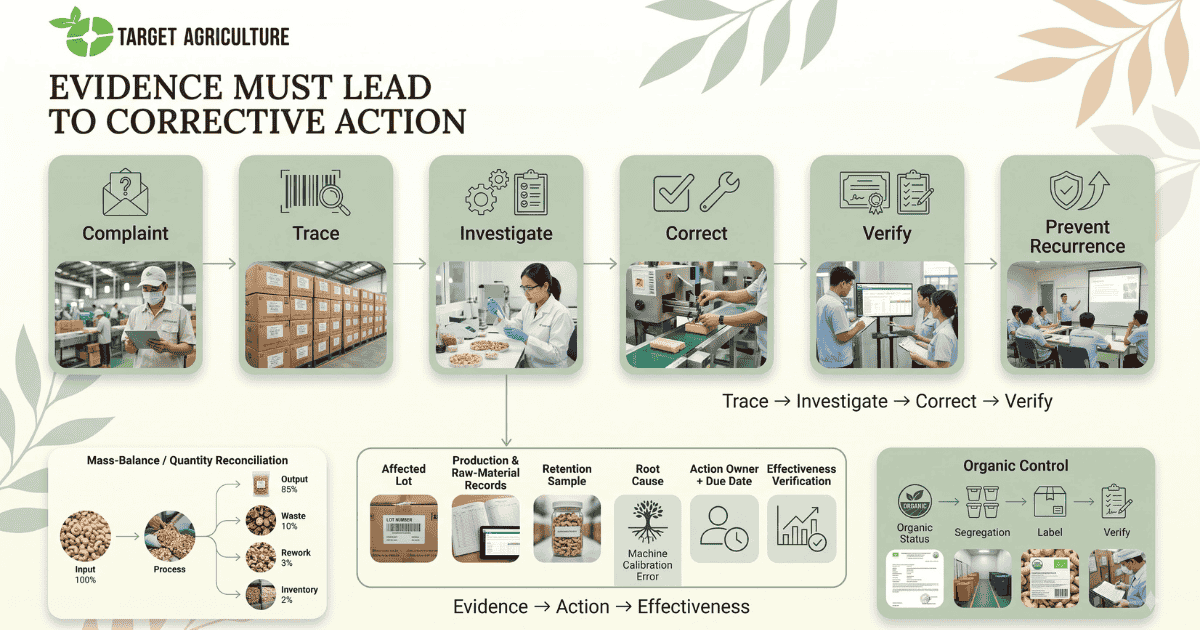
A complaint tests more than conformity to specification. It shows whether a supplier can identify the implicated lot, reconstruct its lot genealogy, locate associated product throughout the distribution chain, assess risk, and implement a documented product disposition before the issue expands.
As an Organic Cashew Exporter Vietnam, Ziellandwirtschaft treats traceability as an operational control across approved sourcing, raw-material intake, processing, packing, finished-product release, warehousing, and export documentation. The objective is practical: evidence-based responses, controlled product disposition, and dependable purchasing decisions for every order. Contact our team to discuss your specification and traceability requirements.
 YOUTUBE - LINKEDIN