



Cashews don't spoil like fresh produce, but they don't last forever either. Here's what published research says about maximizing cashew nut shelf life.
Cashews have a reputation as a "shelf-stable" snack — no refrigeration required, no rapid spoilage like fresh produce. That reputation is true, but only within limits. Left in the wrong conditions, cashews lose crispness, develop off-flavors, and in humid environments, can support mold growth well before any printed best-by date.
According to a peer-reviewed review of tree nut storage published in Postharvest Biology and Technology (ScienceDirect), shelf life in nuts like cashew is determined mainly by two mechanisms: oxidative rancidity, caused by the breakdown of fats and oils on exposure to oxygen and light, and to a lesser extent hydrolytic reactions tied to moisture content. Because cashews are naturally high in fat, they're particularly vulnerable to the first mechanism if stored carelessly.
Moisture is the more visible risk. Research on roasted cashew kernels found that nuts at 11% moisture content developed mold within just 10 days of storage (Balasubrahmanyam et al., cited in a peer-reviewed storage study, EuropePMC) — a reminder that "shelf-stable" doesn't mean "immune to moisture."
The same Postharvest Biology and Technology review sets out specific benchmarks for ideal tree nut storage: temperatures between 4–15°C, kernel moisture around 2.5%, relative humidity of roughly 40–60%, oxygen concentration below 2.5%, and dark conditions to limit light-driven oxidation.
For retailers without dedicated cold storage, the practical takeaway is less about hitting every number precisely and more about the direction: cooler, drier, darker, and lower-oxygen environments consistently outperform warm, humid, brightly lit storage rooms.
Storage conditions matter, but so does what's actually standing between the cashew and the environment around it. A 2025 packaging study (Academia.edu, peer-reviewed research) compared vacuum-sealed bags, zip-lock bags, and plastic jars over a 90-day storage period. Vacuum-sealed packaging held moisture content at 3.93% and pH at 6.62, significantly outperforming the other formats and showing markedly smaller changes over time.
The takeaway for distributors and retail buyers: two batches of cashews with identical starting quality can age very differently depending on the packaging format alone, independent of the storage room itself.
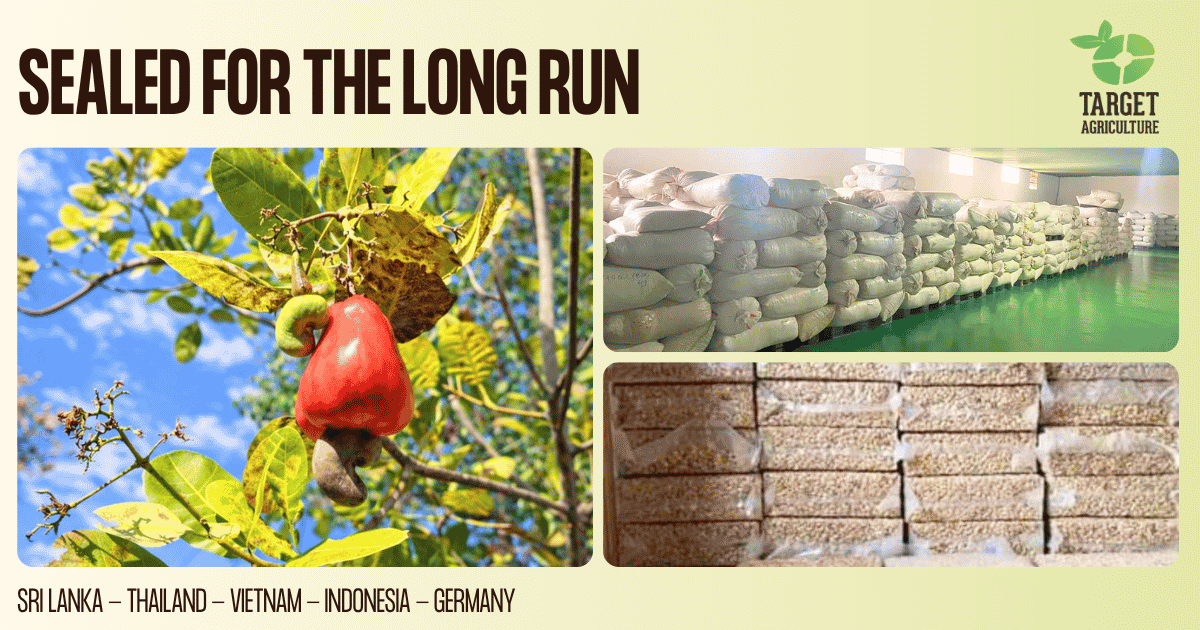
At Target Agriculture, this research isn't just background reading — it shapes how we package for export. Our facilities use nitrogen-flushed vacuum packaging designed to limit oxygen exposure at the source, alongside moisture monitoring throughout processing, so that the shelf life clock starts as late as possible rather than the moment a container leaves the factory.
Cashews don't need refrigeration to stay safe, but treating them as indestructible is a mistake that shows up on the shelf. The research is consistent: control moisture, limit oxygen exposure, keep things cool and dark, and choose packaging that actually protects against all four.
Brand Statement: As a certified organic cashew exporter in Vietnam, Target Agriculture builds these storage principles into our packaging and quality control from the factory floor, helping our partners receive product that's positioned to stay fresh long after it reaches their shelves.
 YOUTUBE - LINKEDIN