


Food-safety risks can emerge at every stage of cashew processing. Discover the key control points buyers should examine before choosing a reliable processor.
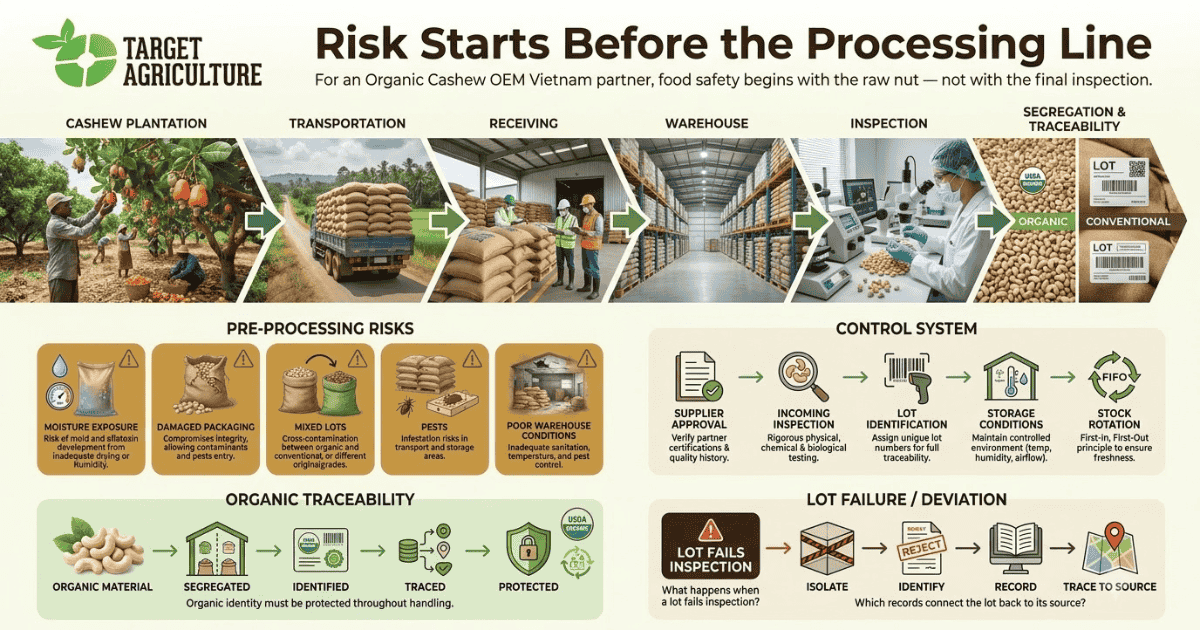
For an Organic Cashew OEM Vietnam partner, food safety begins with the raw nut—not with the final inspection. Moisture exposure during harvest, transport, or storage can reduce stability. Damaged packaging, mixed lots, pests, and poor warehouse conditions can also introduce biological, chemical, or physical hazards before production starts.
A credible processor therefore controls supplier approval, incoming inspection, lot identification, storage conditions, and stock rotation. Organic status adds another layer: the material must remain segregated and traceable so that its identity is protected throughout handling. Buyers should ask what happens when a lot fails inspection, how it is isolated, and which records connect it to its source.
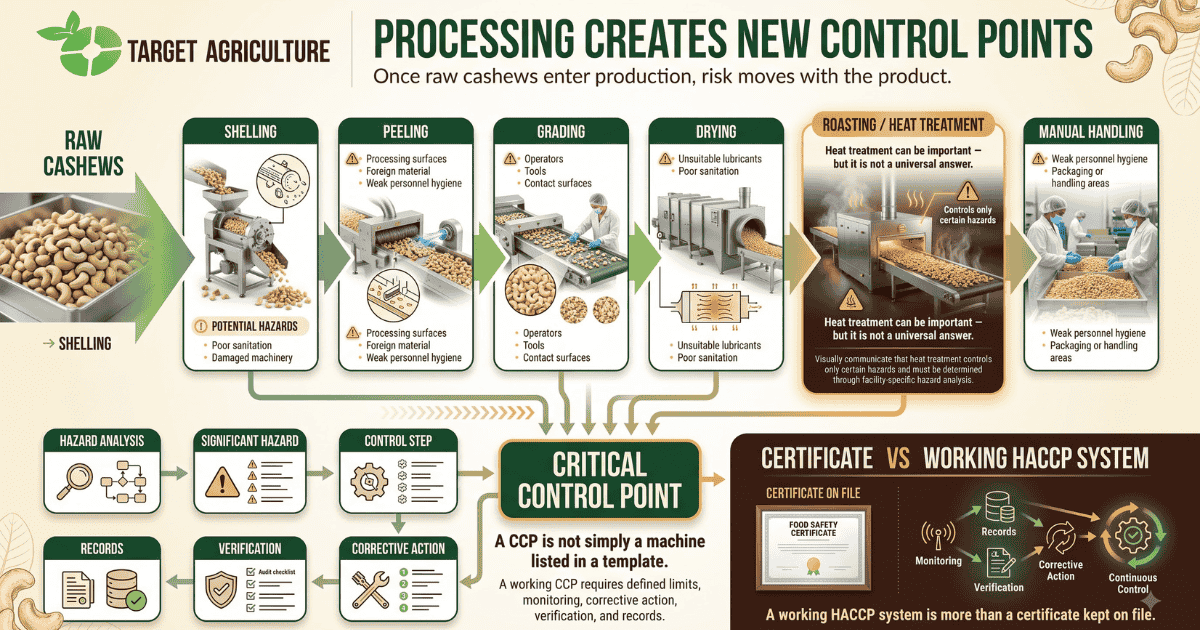
Once raw cashews enter production, risk moves with the product. Shelling, peeling, grading, drying, roasting, and manual handling create repeated contact with equipment, surfaces, tools, and people. Poor sanitation, weak personnel hygiene, unsuitable lubricants, or damaged machinery may introduce contamination or foreign material.
Heat treatment can be important, but it should never be treated as a universal answer. Each facility must use its own hazard analysis to decide which hazards are significant and where control is essential. A Critical Control Point is not simply a machine listed in a template; it is a step supported by defined limits, monitoring, corrective action, verification, and records. That distinction separates a working HACCP system from a certificate kept on file.
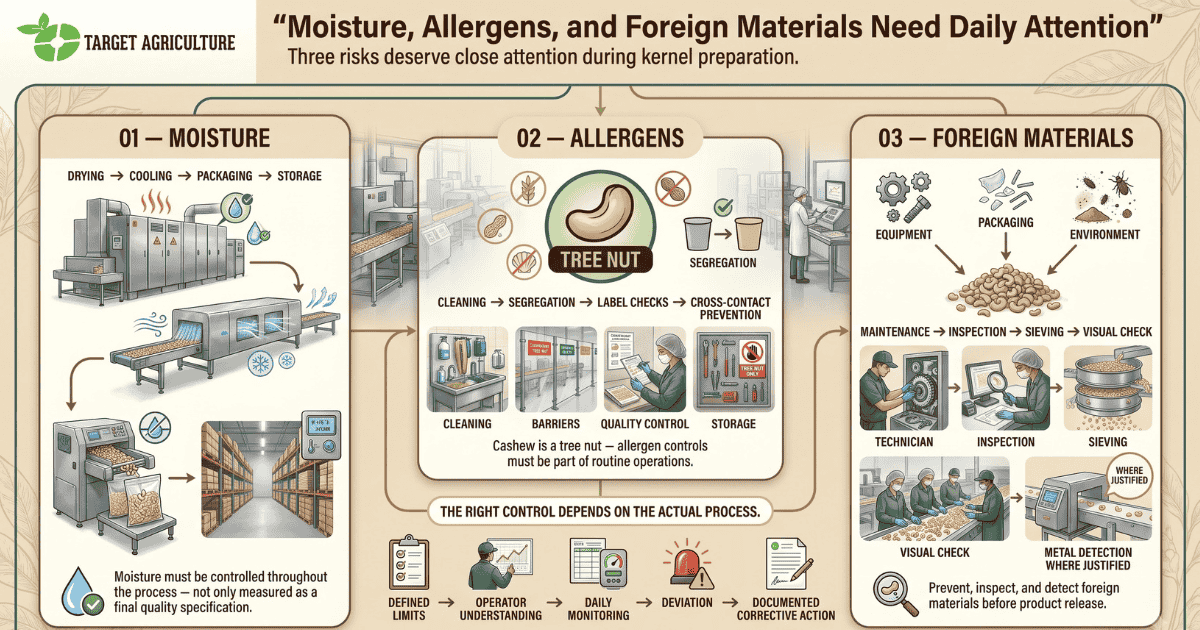
Three risks deserve close attention during kernel preparation. First, moisture must be controlled through drying, cooling, packaging, and storage—not only measured as a final quality specification. Second, cashew is a tree nut, so allergen controls, cleaning, segregation, label checks, and market-specific requirements must be built into routine operations. Third, fragments from equipment, packaging, or the environment must be prevented and detected through maintenance, inspection, sieving, visual checks, or metal detection where justified.
The right control depends on the actual process. Buyers should look for evidence that limits are defined, operators understand them, and deviations trigger a documented response rather than an informal decision.
Food-safety risk does not end when kernels leave the line. Incorrect labels, damaged seals, unsuitable packaging, high humidity, or poor pest control can compromise a finished lot during packing and storage. Clear release procedures and shipment checks are therefore part of the same control system.
Traceability makes that system testable. A processor should be able to connect each lot to incoming material, production dates, monitoring records, inspection results, corrective actions, and shipment documents. During supplier approval, buyers can focus on a short set of practical questions:
- Which hazards are significant for this specific process?
- Where are they controlled, and how are limits monitored?
- What happens to product when a deviation occurs?
- How quickly can one shipment be traced backward and forward?
These questions reveal more than a certificate alone. They show whether food safety is part of daily decision-making.
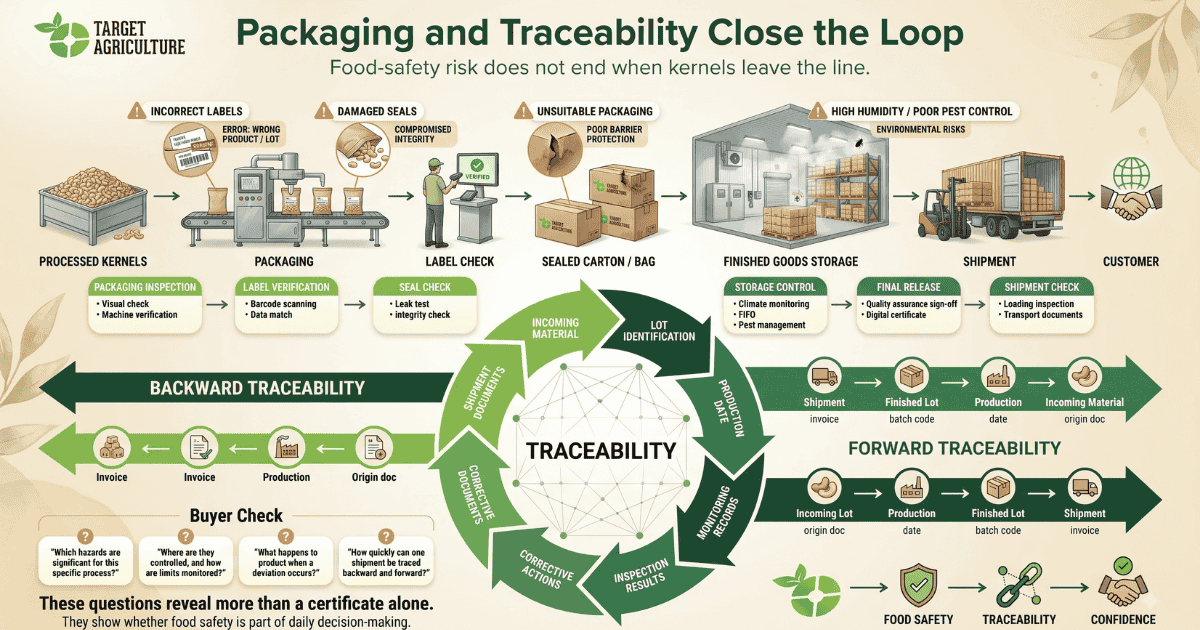
Food-safety risks in cashew processing can appear before production, at contact points on the line, during moisture and allergen control, and after packing. Strong suppliers manage these risks as one connected system: preventive programs support HACCP, records support verification, and traceability supports fast action when something goes wrong.
At Target Agriculture, we believe reliable sourcing is built on visible controls and clear documentation from lot intake to shipment. If you need an organic cashew partner that can align processing, product specifications, and traceability with your market requirements, contact our team to discuss your next program.
👉 If you need an organic cashew partner that can align processing, product specifications, and traceability with your market requirements, contact our team to discuss your next program.
 YOUTUBE - LINKEDIN