


Conventional cashews are cheaper. Organic cashews cost more. But the real question buyers rarely ask is: what exactly are you paying for — and what are you paying to avoid?
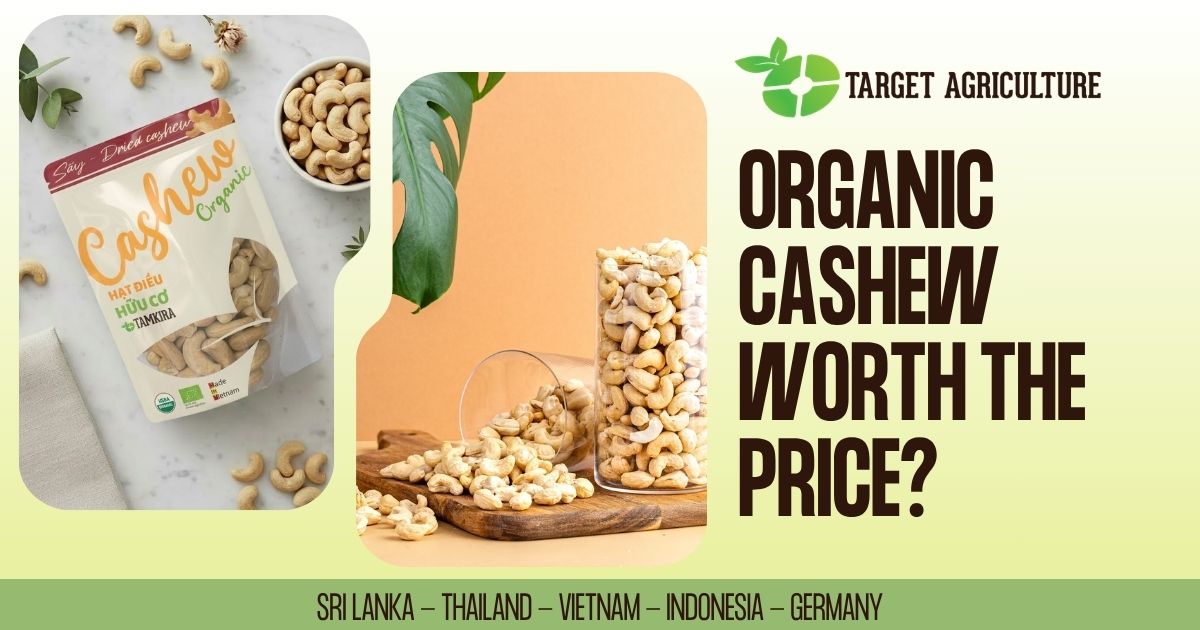
Walk into any sourcing conversation about cashews and the topic of organic vs conventional comes up fast — usually framed around price. Organic costs more. Sometimes significantly more. And for buyers under margin pressure, that difference demands a justification beyond "it's better for you."
The honest answer is that organic cashews cost more to produce because they are harder to produce. Understanding why is what allows buyers to make the decision that actually fits their business — not just the one that fits their budget.
Conventional cashew farming uses synthetic inputs that organic farming prohibits: chemical fertilizers to accelerate growth, pesticides to manage pests and disease, and fungicides to reduce post-harvest losses. These inputs are effective and significantly reduce the unpredictability of farming — which is why conventional cashews are cheaper and more consistently available at scale.
The trade-off is residue. Conventionally grown cashews may carry detectable levels of pesticide residues — within legal limits in most markets, but increasingly scrutinized as import standards tighten. The EU's evolving MRL (Maximum Residue Limit) framework, and the incoming MOAH regulations effective January 2027, are part of a broader regulatory trend that is narrowing the window for conventional products in premium markets.
For buyers selling into European or US organic retail channels, conventional is simply not an option. For buyers in food manufacturing or ingredient supply, the calculus is more nuanced — but the direction of regulatory travel is clear.
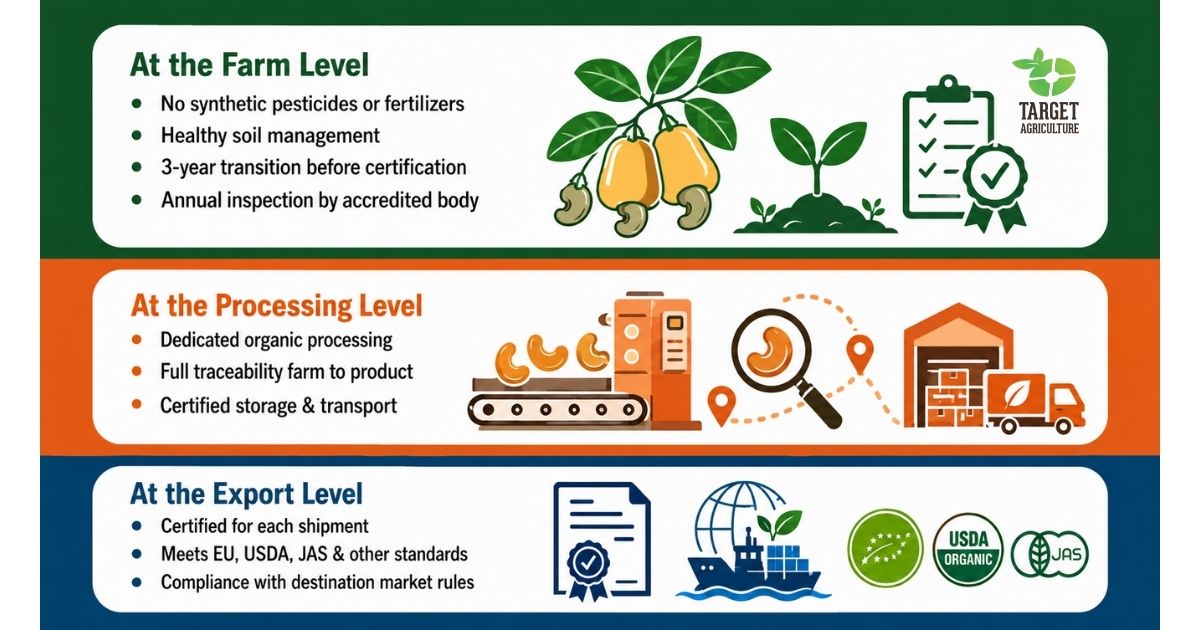
The word "organic" on a cashew pack is not a marketing claim — it is a verified statement backed by annual third-party audits. To carry an organic label for EU or US markets, a product must meet specific requirements at every stage of the supply chain:
At the farm level:
- No synthetic pesticides, herbicides, or chemical fertilizers
- Soil management practices that maintain or improve soil health
- A documented transition period of typically 3 years before land can be certified organic
- Annual inspection by an accredited certification body
At the processing level:
- Dedicated organic processing lines or verified cleaning procedures to prevent cross-contamination
- Documented lot-by-lot traceability linking processed product back to certified farm origin
- Certified storage and transport conditions
At the export level:
- Transaction certificates issued for each shipment by the certifying body
- Compliance with the specific organic regulation of the destination market — EU Organic, USDA-NOP, JAS, and others each have distinct requirements
This is why genuine organic certification is resource-intensive. And it is why the price premium exists.
For buyers sourcing organic cashews, the risk is not just paying too much — it is paying for organic and receiving something that does not hold up under audit.
Organic fraud in the global nut trade is a documented problem. Products falsely certified, mislabeled, or cross-contaminated during processing have reached major markets and been recalled or delisted. The reputational and financial consequences for the brand — not the supplier — are significant.
The practical safeguards buyers should require:
- Valid transaction certificates from an accredited certification body for every shipment
- Lot-level traceability linking the shipment to specific certified farms
- Supplier audit history — how long have they held organic certification, and have there been any non-conformances?
- Processing facility certification — not just product certification
At Target Agriculture Vietnam, organic certification has been in place continuously since 1995 — over 30 years of uninterrupted certified organic operations. Every shipment of organic cashews from our Binh Phuoc supply chain comes with full transaction certificate documentation under EU Organic, USDA-NOP, JAS, Naturland, and Bio Suisse — covering every major destination market our buyers operate in.
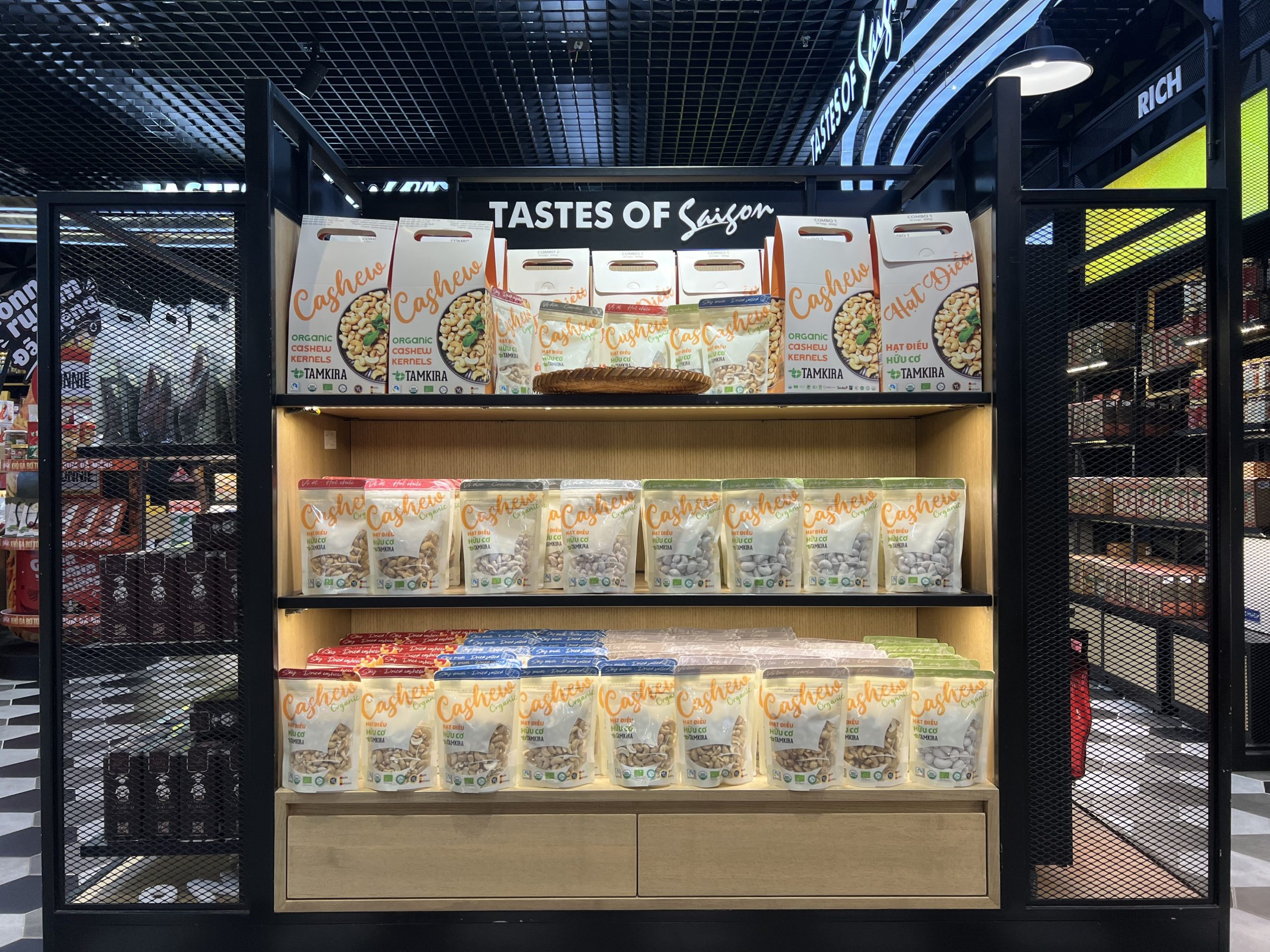
The demand picture for organic cashews has shifted in recent years. What was once a niche category driven by health food specialists is now a mainstream requirement in European retail, a growing expectation in US natural food channels, and an emerging premium in Asian markets.
Key demand drivers:
- European supermarket chains expanding organic own-brand ranges
- US natural and specialty retailers requiring organic certification as a baseline
- Growing consumer awareness around pesticide residues and clean-label products
- Regulatory tightening making conventional products harder to sell into premium channels
For suppliers, this means the organic capability gap between exporters is widening. Those who have invested in certified organic supply chains — with the farm relationships, processing discipline, and documentation systems that certification requires — are increasingly difficult to replicate quickly.
Choosing between organic and conventional cashews is ultimately a market positioning decision. If your end market is price-sensitive commodity retail or industrial food manufacturing, conventional may still be appropriate. If your end market is organic retail, health food, premium private label, or any channel where your buyer or consumer will look at the label — organic certification is not optional.
The more important question is not organic vs conventional. It is: which organic supplier has the depth of certification, the processing consistency, and the supply chain transparency to support your brand long-term?
Target Agriculture Group has been answering that question for buyers in Europe, the United States, Japan, and Australia for over three decades — from certified organic cashew farms in Binh Phuoc, Vietnam to retail shelves worldwide.
The price difference between organic and conventional cashews reflects a real difference in how they are produced, verified, and documented. For buyers in regulated markets or premium retail channels, that difference is not a premium — it is the cost of market access.
Understanding what drives organic certification costs, what risks come with cutting corners, and what to look for in a supplier is what separates buyers who source confidently from those who find out the hard way.
👉 Contact Target Agriculture to request organic certification documentation, product samples, or discuss your sourcing requirements.
 YOUTUBE - LINKEDIN